
The image
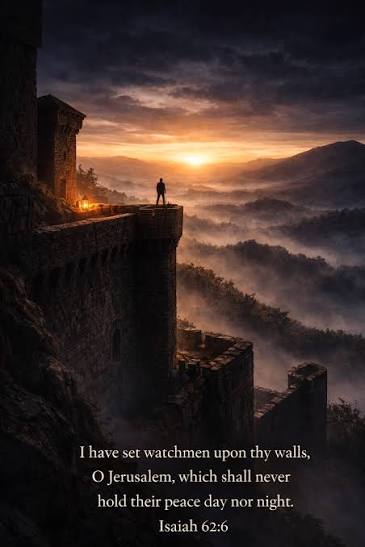
Long before the vocabulary of ministry or mission or outreach existed, every ancient city understood the figure immediately: the man on the wall.
The wall was the boundary between safety and danger, between the known and the unknown, between the community gathered inside and everything that threatened it from without. And on that wall, in darkness and in cold, through the long hours when the rest of the city slept, stood the watchman.
Facing the darkness, scanning the horizon for what was coming, he was the furthest point of the community’s awareness; What he saw, the city would know; What he missed, the city might not survive.
His task was not to fight what was coming. His task was to see it first. And then to warn.
This is the image God creates in Ezekiel 33. Not a general. Not a king. Not a philosopher. A watchman. It is a specific, concrete, demanding role. And it comes attached to a weight that most roles do not carry — the weight of accountability for what happens to others because of what you did or did not do.
God makes it personal
The shift from the general principle in verses 1–6 to the personal appointment in verse 7 is significant. God does not say: someone should be a watchman. He says: I have made you one. The call is not abstract. It is addressed. It has a name on it.
…and then comes the weight
Most roles we take on in life carry conditional accountability. A doctor is accountable if he makes a clinical error. A builder is accountable if the structure fails. But in both cases, the accountability is bounded by what they did or did not do within their defined professional scope. They are not accountable for what happened to people they never encountered.
The watchman’s accountability works differently. It extends not only to what he did, but to what happened to others because of what he failed to do. God says it plainly: if the watchman sees the sword coming and does not blow the trumpet, and someone dies in their iniquity — He will hold the watchman accountable for their blood.
Responsibilities
There are three role-players in Ezekiel 33: the People, the Watchman, and God.
PEOPLE: The people carry their own responsibility. If they hear the warning and choose to ignore it, their blood is on their own head. The watchman cannot be held accountable for the choices of others.
GOD: In this passage (Ezekiel 33), God is not a distant administrator. He is the one who appoints the Watchman. He is the one who will call the Watchman to account. The watchman answers upward, to God, before he answers outward to the people.
The Watchman: As stated above, the Watchman cannot be held accountable for the choices of others. He cannot compel a response. He cannot force anyone to take shelter. What he can be held accountable for is his own faithfulness — whether he sounded the trumpet when he saw what was coming.
The Call
God does not ask Ezekiel to volunteer. He does not put out a general request and wait to see who might be interested. He says: I have made you a watchman. The appointment is prior to the response. The call comes before the acceptance.
The call to be a watchman is not primarily a decision you make about yourself. It is something that happens to you — an awareness, growing over time, that there are people in your sight whose danger you cannot unsee, and whose safety you have become responsible for (In some sense you did not choose this responsibility.) The question is not whether you are capable. The question is whether you will be faithful.